
Integration Decision Guide
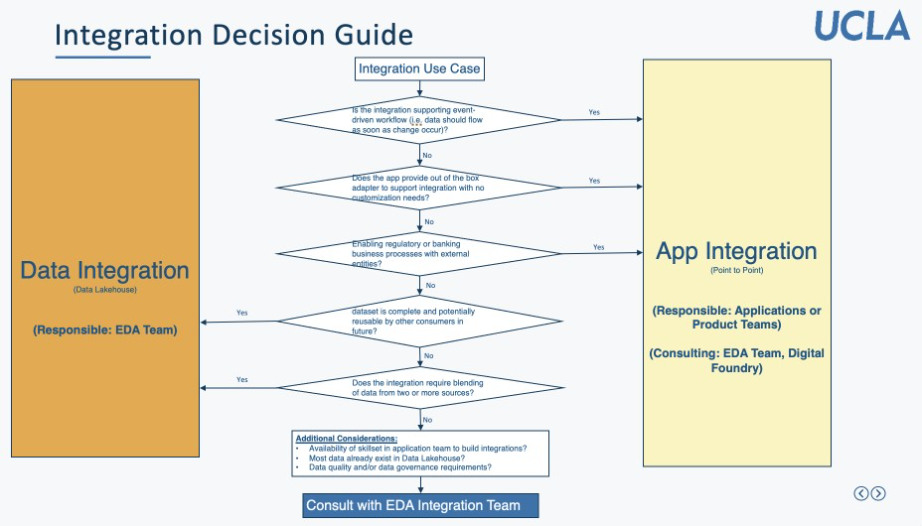
What This Guide Helps You Decide
This guide is designed to help project teams determine the most appropriate architectural model for an integration. In fact, many solutions involve collaboration between both patterns.
When to Use a Data Integration Architecture
Use this pattern when the goal is to prepare and distribute data as a reusable asset.
✅ Best suited for:
- Combining, transforming, or aggregating data from multiple sources
- Producing curated, reusable datasets for analytics, reporting, or downstream consumption
- Applying business rules, reconciliations, or quality checks to ensure trust
- Storing outputs in a centralized data lakehouse or warehouse
This architecture emphasizes data transformation, consistency, and reusability — not just movement. While it often works on scheduled or batch cycles, it can also support streaming pipelines when enrichment or modeling is needed.
When to Use an Application Integration Architecture
Use this pattern when the goal is to connect systems to enable business process flows or transactional exchanges.
✅ Best suited for:
- Real-time or event-driven workflows (e.g., approvals, alerts, syncs)
- Point-to-point communication between two systems
- Triggering business logic in one system based on activity in another
- Supporting integration with external vendors, services, or regulatory agencies
This architecture focuses on orchestration, triggering, and communication between systems — not on reshaping or blending data for reuse. It’s optimized for speed and responsiveness, not for data curation.
Final Thought
Some integrations may involve both patterns — for example, data flowing in real-time via Application Integration, then landing in the Lakehouse for enrichment and reporting via Data Integration. Use this guide to select the dominant architectural need and consult with integration team if the use case spans both.